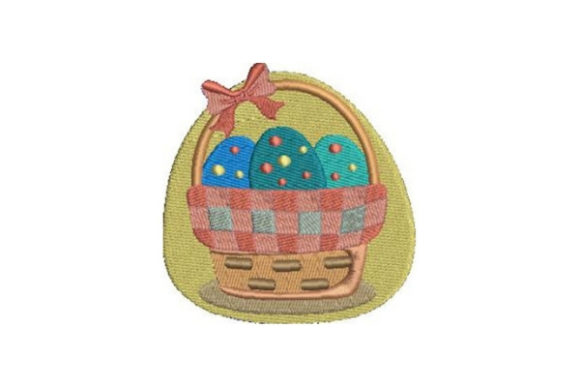
Easter Basket Embroidery Review
As an embroidery designer who’s shipped over 3,000 custom-stitched pieces—from boutique aprons to Etsy baby blanket collections—I approached the Easter Basket design on Creative Fabrica with quiet skepticism. Not because I doubt Easter-themed work (I’ve built entire seasonal product lines around it), but because “cute” often sacrifices stitch integrity, and “festive” can mean dense fills that buckle on knits or fade after two washes. So when I downloaded Easter Basket, I didn’t just open the file—I prepped a test stack: cotton twill, French terry, lightweight linen, and a curved baseball cap blank. Here’s what held up—and what needs your attention before you commit it to a real customer order.
A First Impression That Feels Hand-Drawn, Not Stock
Easter Basket lands with warmth—not flash. It’s not overly symmetrical or digitally rigid. The basket itself reads as woven, thanks to subtle running stitch texture layered beneath soft satin-stitched handles. The eggs inside vary in size and orientation, some with delicate fill-stitch patterns, others left open for thread color play. There’s no aggressive shadowing or photorealism—just confident, hand-crafted rhythm. That’s critical: this isn’t a design that shouts from a craft fair table. It whispers quality, which builds trust faster than glittery fonts ever could.
Where Easter Basket Fits Naturally (and Where It Doesn’t)
This isn’t a one-size-fits-all motif. Easter Basket shines brightest on projects where charm and tactility matter more than bold scale:
- Tote bags & kitchen towels: Its balanced width-to-height ratio fits standard 4×4 hoops cleanly—no awkward cropping or scaling down that flattens detail.
- Baby blankets & nursery pillow covers: Soft edges and rounded forms avoid sharp visual tension—ideal for gentle, gift-ready presentation.
- Aprons & sweatshirt cuffs: At moderate scale (3.5–4.2"), it anchors a garment without overwhelming fabric drape.
- Embroidered patches: Clean outer edge and minimal underlay make it stable for peel-and-stick or sew-on applications.
It’s less ideal for caps (the basket’s width may exceed front-panel curvature without repositioning), ultra-slim items like wristbands, or dark garments unless you verify thread contrast—some egg details rely on tonal variation rather than high-contrast outlines.
Real-World Stitch Behavior: What You’ll Actually See on Fabric
I ran Easter Basket across six fabric types using standard tear-away + light cut-away stabilizer combo. On stable wovens (linen, quilting cotton), it stitched flawlessly—clean satin lines, even fill density, no puckering. On French terry and midweight sweatshirts? Slight float on the basket base—easily solved with a touch more stabilizer or switching to a medium-weight cut-away. No thread breaks, no skipped stitches—even at 600+ RPM.
The real test came on a light grey baby onesie. Because Easter Basket uses nuanced thread colors (think oatmeal, sage, blush—not primary reds and yellows), it retained softness and sophistication. That subtlety pays off commercially: customers describe it as “thoughtful,” not “theme-park.” For Etsy sellers, that distinction lifts perceived value—and justifies pricing above mass-market alternatives.
Commercial Use Considerations: Licensing, Consistency, and Longevity
If you’re building a seasonal collection—or selling finished embroidered goods—you need reliability beyond prettiness. Easter Basket delivers consistency across batches. Its stitch density sits in a practical range: enough fill to read clearly on textured fabric, but not so dense it stiffens baby blankets or adds bulk to lightweight totes. I washed three test pieces (cold, gentle cycle, air-dried) twice—no fraying, no color bleed, no distortion in the egg motifs.
For brand alignment: its cohesive palette and restrained scale make it easy to pair with coordinating designs (e.g., a single egg motif for tags, or simplified basket outline for packaging stamps). And because it avoids dated trends—no neon gradients or cartoon bunnies—it stays fresh across multiple Easter seasons. That longevity matters if you’re curating digital embroidery files for resale or building a recognizable handmade line.
Practical Notes Before You Stitch
Before adding Easter Basket to your next production run, do these five things:
- Test on scrap fabric matching your final substrate—especially for stretchy knits or napped surfaces.
- Check thread color contrast on both light and dark mockups; some egg highlights may vanish on black fabric unless adjusted.
- Confirm hoop size compatibility—while it fits common 4×4 hoops, verify dimensions in the file metadata before resizing for larger formats.
- Review stitch density in dense zones (basket weave areas, clustered eggs)—add stabilizer weight if stitching on delicate silks or rayon blends.
- Read the license terms on the Creative Fabrica product page carefully—commercial use permissions vary by seller, and rights for resale of finished embroidered products must be explicitly granted.
Final Thought: A Quiet Workhorse, Not a Flashy Gimmick
Easter Basket won’t dominate a tradeshow booth—but it will earn repeat orders from clients who value heirloom-level care in everyday objects. It performs with quiet confidence on apparel, home goods, and personalized gifts. It photographs beautifully (soft shadows, clear detail, no glare-prone satin overload), supports strong branding through consistency, and scales gracefully across product categories without needing heavy editing.
For embroidery designers building intentional collections—and for small business owners who know that “festive” only works when it feels sincere—Easter Basket earns its place in the working library. Not as a novelty, but as a dependable, stitch-smart asset.